
December 9, 2025
2 min read
Add Us On GoogleAdd SciAm
Astronomers Spot the Most Ancient Supernova Ever Observed
Astronomers have sighted the oldest known stellar explosion, dating back to when the universe was less than a billion years old
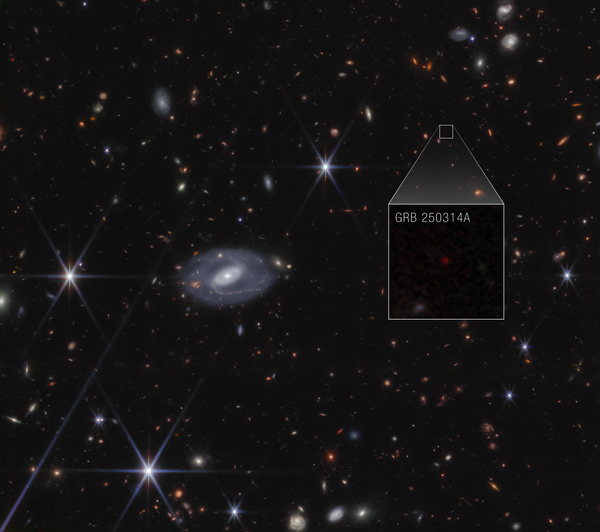
NASA’s James Webb Space Telescope identified the source of a super bright flash of light known as a gamma-ray burst: a supernova that exploded when the universe was only 730 million years old.
NASA, ESA, CSA, STScI, Andrew Levan (Radboud University); Image Processing: Alyssa Pagan (STScI)
The James Webb Space Telescope has observed the oldest known supernova—the explosive death of a star that lived when the universe was only 730 million years old.
The ancient blast occurred when the cosmos was just 5 percent of its current age, and the supernova’s light has been traveling through space ever since. Astronomers were surprised to find that this primeval explosion strongly resembles today’s supernovae, which occur when massive stars run out of fuel for the nuclear fusion reactions that power them and then collapse under their own gravity.
Scientists had suspected that the universe’s earliest supernovae might look different because they represent the deaths of some of the first stars. Compared with today’s stars, they formed in a smaller, denser cosmos and contained lighter elements—mainly hydrogen, helium and trace amounts of lithium. And they were more massive than modern stars.
On supporting science journalism
If you’re enjoying this article, consider supporting our award-winning journalism by subscribing. By purchasing a subscription you are helping to ensure the future of impactful stories about the discoveries and ideas shaping our world today.
Astronomers first spotted this primordial supernova in March, thanks to a 10-second-long flash of high-energy light known as a gamma-ray burst. Such a burst can be caused by a collision between a black hole and a dense object called a neutron star or—as in this case—by the death of a large star.
A telescope that scans for ephemeral events in space called the Space-Based Multi-Band Astronomical Variable Objects Monitor (SVOM) first detected the flash on March 14. That detection quickly set off a chain of observations around the world, including by NASA’s Neil Gehrels Swift Observatory, which pinpointed the flash’s location on the sky, the Nordic Optical Telescope on the Canary Islands, which suggested it was very far away, and the European Southern Observatory’s Very Large Telescope in Chile, which determined its age.
Because the object was so ancient, its light has been stretched as space has expanded over time. As a result, the light from the initial supernova that caused the gamma-ray burst was expected to become brightest a few months after the burst was sighted. The James Webb Space Telescope saw it in July, confirming that the flash was caused by a supernova, which has been designated GRB 250314A. The powerful observatory was also able to spot the galaxy that hosted the exploded star, although it appeared only as a small red smudge.
It’s Time to Stand Up for Science
If you enjoyed this article, I’d like to ask for your support. Scientific American has served as an advocate for science and industry for 180 years, and right now may be the most critical moment in that two-century history.
I’ve been a Scientific American subscriber since I was 12 years old, and it helped shape the way I look at the world. SciAm always educates and delights me, and inspires a sense of awe for our vast, beautiful universe. I hope it does that for you, too.
If you subscribe to Scientific American, you help ensure that our coverage is centered on meaningful research and discovery; that we have the resources to report on the decisions that threaten labs across the U.S.; and that we support both budding and working scientists at a time when the value of science itself too often goes unrecognized.
In return, you get essential news, captivating podcasts, brilliant infographics, can’t-miss newsletters, must-watch videos, challenging games, and the science world’s best writing and reporting. You can even gift someone a subscription.
There has never been a more important time for us to stand up and show why science matters. I hope you’ll support us in that mission.